
Crypto Casinos Paying Dividends 2026
- Written by Michal Jur — Crypto Gambling Analyst
- Last Updated: May 7, 2026
Discover how crypto casinos reward users not just for playing, but for holding tokens and staying active. In the crypto space, profits don’t come only from betting — there are smarter ways to earn. If you’re curious, explore the full breakdown of profit-sharing mechanisms.
BetFury offers a mature BFG dividend model with flexible and locked staking options.
BC.Game offers strong upside, but token dilution and changing rewards add risk.
Rollbit rewards can be attractive, but require deeper understanding of NFTs, RLB, and platform mechanics.
Pasino’s FEY model may improve if wagering volume grows, but liquidity and setup are key limitations.
This page contains affiliate links. If you register or place a wager through these links, we may earn a commission — at no additional cost to you. Sports betting is restricted to individuals 18+ or 21+, depending on regional laws. Always verify that online gambling is legal in your jurisdiction before creating an account. Please gamble responsibly. Never wager more than you can afford to lose.
Crypto Casinos Paying Out Dividends 2026 (Expert's List)

- Best for: Complex Bonus Program
- Bonus: Up to 590% Bonus up to $10,500 + Free Spins
- Games: 7,100+ Slots | Originals | Live Casino | Sports | Crypto Trading
- Feature: Crypto Staking with high APR %

- Best for: All-round crypto gambling platform
- Bonus: Up to $20,000 Bonus with cashback and rakeback
- Games: 6,800+ Slots | Originals | Live Casino | Sports | Crypto Trading
- Feature: BC.GAME Engine - Profit-sharing mechanism

- Best for: All-round crypto gambling platform
- Bonus: Rakeback + Daily, Weekly & Monthly Bonus
- Games: 4,800+ Slots | Originals | Live Casino | Sports | Crypto Trading
- Feature: Native NFTs collecting revenue share

- Best for: No KYC Crypto fast-paced gameplay
- Bonus: Rakeback and level up rewards
- Games: 680+ Slots | Originals | Live Casino
- Feature: Feyorra token - profit sharing system
What Are Crypto Casino Dividends?
Crypto casinos are pushing the industry forward with new mechanics that extend beyond simple betting. In some cases, players can participate in the platform’s operations and gain exposure to the casino’s performance through profit-sharing models.
What you will learn:
- How profit-sharing works
- Which platforms perform best
- Risks and realistic returns
TL;DR: Users hold and stake casino tokens to receive a share of platform-generated revenue, typically funded by the house edge.
How Profit-Sharing Works in Crypto Casinos
There are multiple ways casinos allow players to participate in the operation to gain personal gain. Among the most used mechanisms are:
- Revenue Share Tokens (House Edge Distribution): Token holders can stake native tokens to receive a share of the casino’s generated revenue, typically derived from the house edge.
- Crypto Staking Rewards: Some platforms allow users to stake supported cryptocurrencies directly on-site to earn yield, although returns often depend on platform activity and may be tied to gameplay or reward systems.
- NFT-Based Revenue Sharing: Certain casinos offer NFT collections that grant holders access to revenue-sharing mechanisms, where rewards are distributed based on ownership and platform performance.
If you’re looking to participate in these revenue-sharing and token reward systems, there are several approaches available. In the following sections, we’ll break down each mechanism in detail and highlight the key risks to consider.
Types of Profit-Sharing Models Explained
This section breaks down the most common mechanisms crypto casinos use to share revenue with users.
Revenue Share Tokens (House Edge Distribution)
The most common model you’ll encounter is revenue sharing through native tokens. To participate, you first need to acquire the casino’s token — either through gameplay rewards or by purchasing it on the market. In most cases, these tokens must then be staked, after which a share of the platform’s revenue is distributed to your balance over time.
Overall, this is a relatively clean and accessible way to participate in profit-sharing, even for users without advanced technical knowledge. Expected returns can vary significantly across platforms, with newer casinos sometimes offering higher yields — though these often come with greater uncertainty.
What Drives the Yield?
The most common way crypto casinos distribute rewards is by sharing revenue with token holders. Over time, the casino profits from the house edge, and a portion of that profit is allocated to a reward pool. This pool is then distributed at regular intervals — hourly, daily, or monthly — among token holders, with payouts typically proportional to the amount of tokens staked.
Buyback & Burn Mechanisms
Another model you’ll come across is the buyback-and-burn mechanism, which is less about direct payouts and more about long-term token value.
In this setup, the platform uses a portion of its revenue to buy back its native token from the market and permanently remove it from circulation (“burn” it). This reduces overall supply, which can support price appreciation over time. From a user perspective, this doesn’t generate immediate cash flow like revenue sharing, but it can increase the value of tokens you already hold.
If buybacks and burns are executed according to a clear plan, the model appears more structured and credible. Consistent buybacks funded by real platform revenue can signal long-term commitment and alignment with token holders.
NFT-Based Revenue Sharing
While token-based distribution is the standard model, some casinos take it a step further by incorporating NFTs (non-fungible tokens) into the system.
In this setup, instead of acquiring tokens, users obtain NFTs — either through marketplaces or platform-based rewards — and become eligible for profit-sharing. Rewards are then distributed based on NFT ownership or staking, depending on how the system is structured.
Integrating NFTs into reward systems is something traditional fiat casinos don’t offer, giving crypto-native players the option to participate in such flexible and innovative models.
Crypto Staking Platform
Another model — more familiar in the crypto space in general — is standard crypto staking. Some casinos allow users to stake supported assets with a predefined APR, offering a more predictable return structure. In certain cases, higher yields are available, but these are often conditional on platform activity, such as meeting wagering requirements or maintaining active gameplay.
As you can see, crypto casinos offer a range of approaches to generating returns. The key is to choose a model that aligns with your goals, risk tolerance, and your preferences as a player.
Best Crypto Casinos With Profit-Sharing (Expert Breakdown)
There are numerous crypto casinos offering token-based revenue distribution or other forms of profit-sharing. Below, we provide the list of more credible platforms and break down their earning models, along with the criteria we use to evaluate their trustworthiness.
How We Evaluate Profit-Sharing Platforms
Crypto casinos featured on this page are evaluated using a consistent set of criteria focused on distribution mechanics, tokenomics, reward models, trust metrics, and overall user experience.
Our review process considers the following factors:
- Token model & profit-sharing structure (how rewards are generated, revenue sources, distribution frequency, staking requirements)
- Transparency of returns (clear breakdown of yield sources, realistic APR/APY, visibility into platform revenue or reward pools)
- Token utility & demand drivers (use cases within the platform, staking benefits, gameplay integration, long-term relevance)
- Tokenomics & sustainability (supply model, inflation vs burn mechanisms, lockups, long-term viability of rewards)
- Platform performance & activity (user base, betting volume, game engagement — key drivers behind reward generation)
- Withdrawals & liquidity (ease of converting tokens, withdrawal limits, market liquidity, supported networks)
- Security, reputation & operational track record (platform history, transparency, audits where applicable, support quality)
Top Picks Reviewed
⭐ BC.Game — BC Token and the Rewards Engine
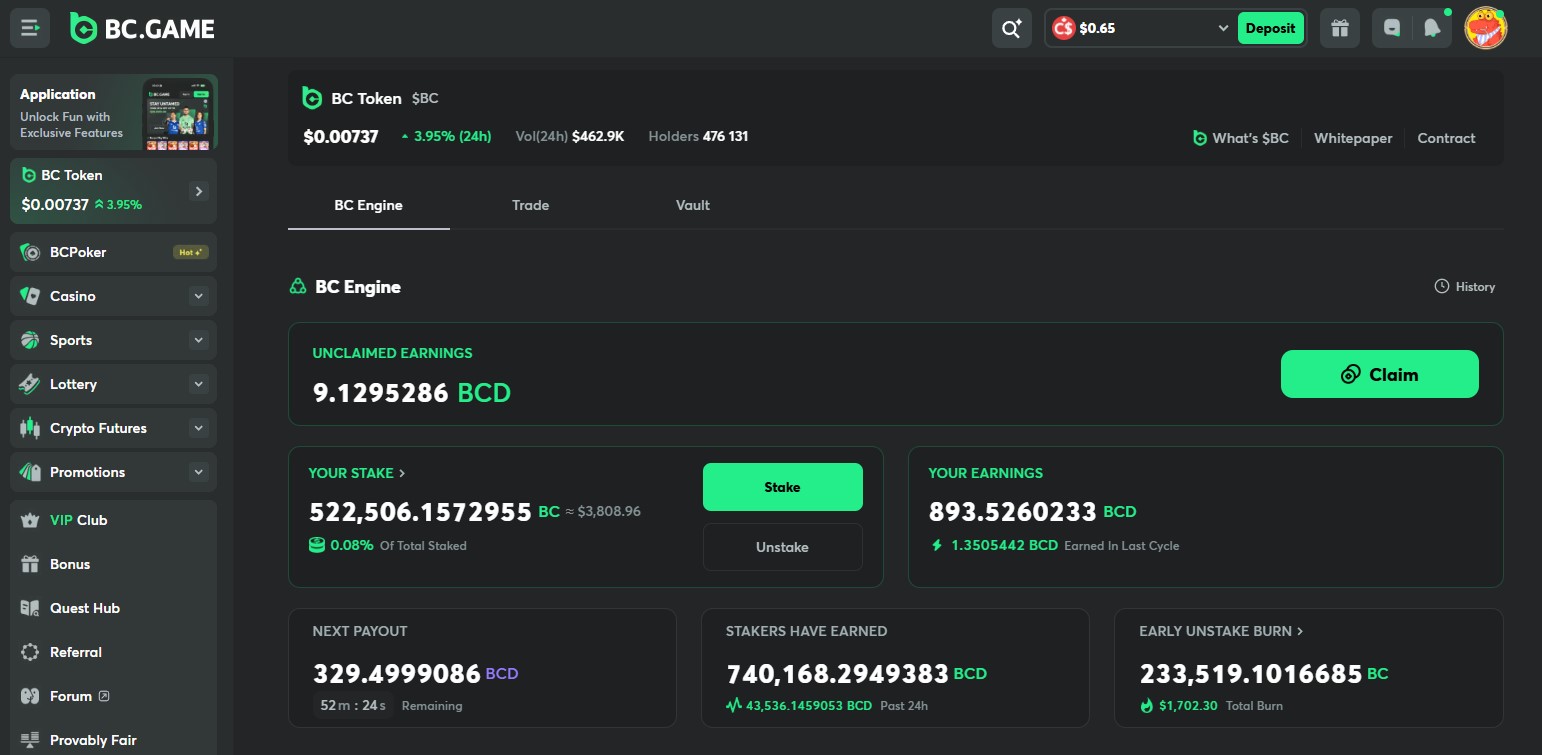
In 2025, BC.Game launched its native BC token ecosystem, although the initial utility and long-term benefits for players were not entirely clear. At first, the token was mainly used for gameplay-related functions and lottery participation. In 2026, the platform introduced the BC Engine, allowing users to effectively “own a share of the house” by staking BC tokens and receiving a portion of casino-generated revenue.
The mechanism itself is relatively straightforward. Users can acquire BC tokens either through gameplay rewards and rakeback or by purchasing them on the market (via DEXs or directly on the platform). After staking tokens in the BC Engine, holders receive dividend payouts every hour. The reward system works proportionally — the more BC tokens staked, the higher the potential payout.
- Active players can turn rakeback into earning asset
- Simple process - no entry barriers
- The casino is generating significant revenue that is being distributed among BC stakers.
- BC tokens inflation through rakeback rewards
- No exact buyback and burn plan
Expert insight: BC.Game is a large crypto casino that introduced a well-developed revenue-sharing system accessible to both active players and crypto users. However, as more BC tokens enter circulation over time, this can create downward pressure on rewards, potentially reducing the overall yield for existing holders.
⭐ BetFury — BFG & Crypto Staking
BetFury offers two main earning mechanisms.
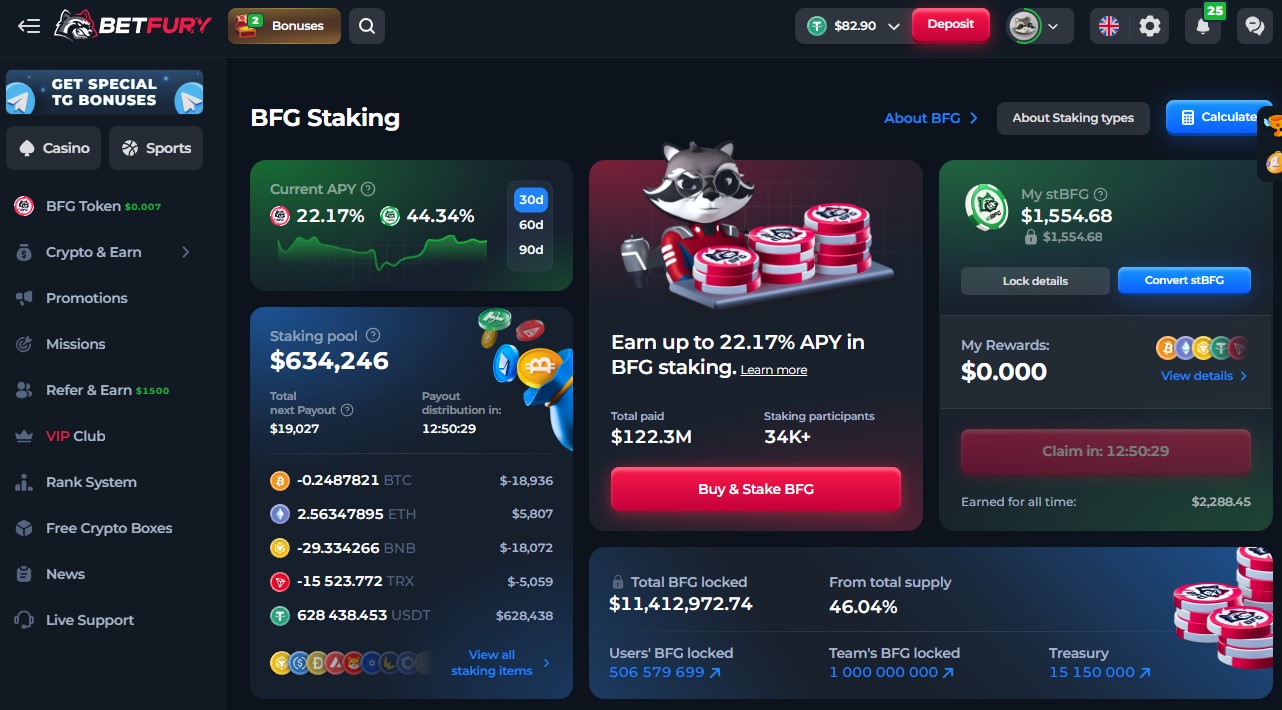
The first is BFG staking, built around its native BFG token, which has been active on the platform for several years. Initially, BFG was distributed through wagering (“wager mining”), but once the full supply was emitted, the model shifted. Today, the token is primarily acquired via markets (DEXes).
BetFury allocates a portion of its platform revenue into a dividend pool, and every day, a percentage of that pool is distributed among BFG holders. The system is relatively straightforward and accessible — rewards are proportional to the amount of tokens held.
After acquiring BFG, users can choose to hold it as-is or convert it into stBFG, the staked version. stBFG offers a higher yield, but comes with a trade-off: tokens are locked for one year, reducing liquidity.
The second earning option is crypto staking via BetFury’s vaults. Users can stake assets such as USDT, ETH, or BTC to earn yield through selected plans. These range from flexible options to higher-yield “booster” plans, in which enhanced returns are usually contingent on meeting wagering requirements tied to the staked amount.
- Straightforward earning opportunities
- High potential yields(even better for active players)
- Gamified environment at the history-proven platform
- $BFG buybacks and burns
- stBFG Locking period
- BFG token price volatility
- High yield offers only for users with significant wagering
Expert insight: BetFury was one of the earlier platforms to introduce token-based reward systems into crypto gambling. It continues to offer competitive yields, supported by a model that has been operating for several years. Ongoing buybacks of the BFG token suggest an effort to stabilize its value and maintain alignment with token holders.
⭐ Rollbit – NFT Revenue Sharing Model
Rollbit takes a more advanced approach by integrating NFTs directly into its reward system. Its Rollbot collections play a key role in the platform’s overall bonus and profit-sharing mechanics, adding another layer beyond traditional token-based models.
Rollbit introduced its native RLB token first, and later expanded the ecosystem with NFT-based rewards. Today, there are two main collections — Rollbots and Sportsbots — each offering different ways to participate in platform-generated value.
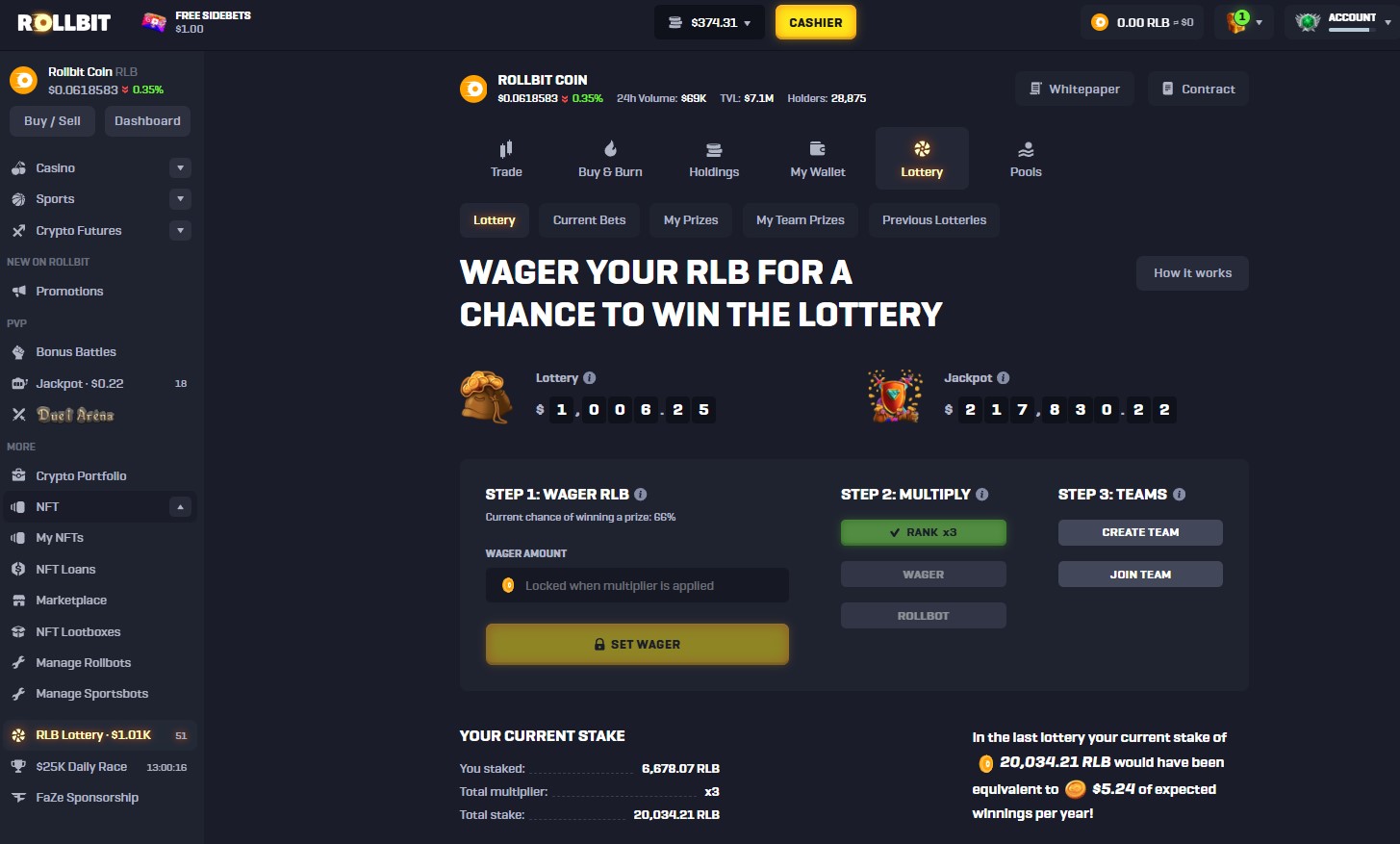
The original Rollbots provide access to a share of revenue from the Rollbit NFT marketplace, enhanced rakeback deals, and boosted odds in the daily RLB lottery.
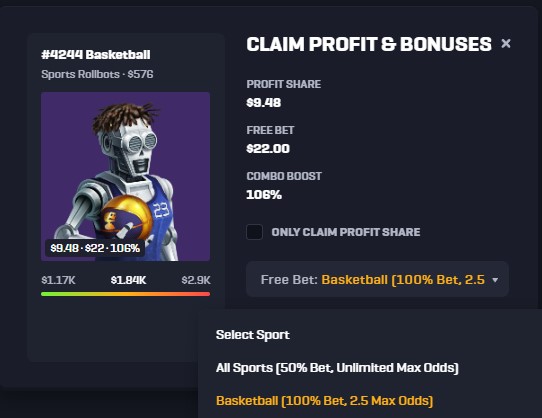
Sportsbots, on the other hand, are more closely tied to the sportsbook side — offering exposure to selected sportsbook profits and periodic free-bet opportunities, where users can place bets without risking their own funds.
- Gamified exciting rewards program with NFTs and RLB tokens.
- Monthly rewards for casino and sportsbook users
- Seamless and user-friendly RLB and NFTs marketplaces
- Volatile rewards
- Requires a deeper understanding of the platform’s features and mechanics
Expert insight: Rollbit stands out for its unique reward ecosystem, combining incentives for active players with additional benefits tied to holding Rollbot NFTs and RLB tokens. For users who enjoy innovative, gamified reward models, it can be a strong fit. On the other hand, more straightforward investors may find it less suitable for the requirement of solid understanding of the platform’s mechanics.
⭐ Pasino — Feyorra Tokens Driven Payouts
Pasino is a smaller crypto casino with relatively low KYC requirements, allowing users to play with a wide range of cryptocurrencies without extensive identity verification.
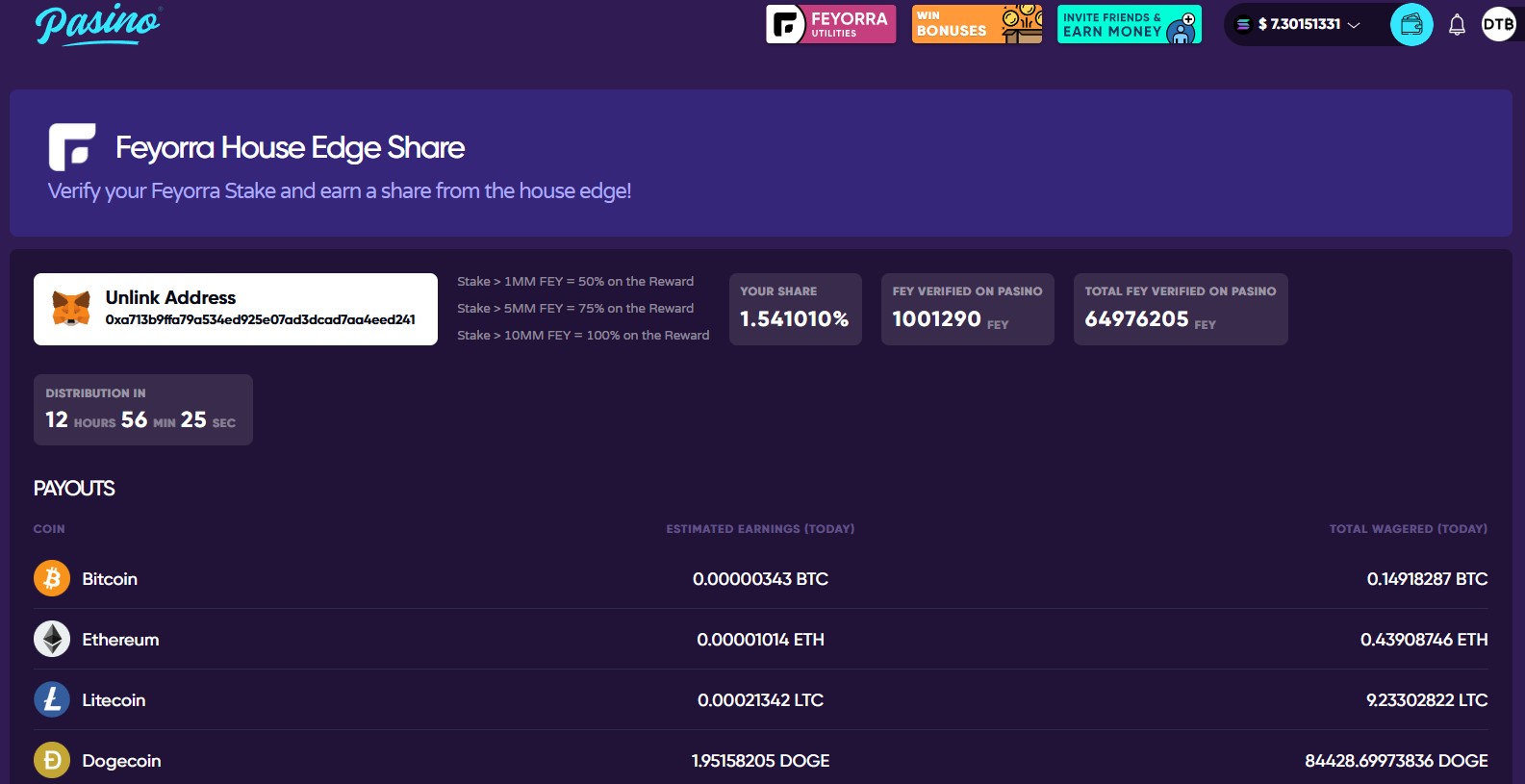
Its profit-sharing model is built around Feyorra (FEY) tokens. To participate, users first need to stake FEY on the Feyorra platform, then link the wallet to the Pasino account to become eligible for daily reward distributions. This creates a two-step system where staking and platform activity are connected.
FEY tokens are distributed through a wager mining mechanism, similar to other crypto casinos, and can also be acquired on the market — although liquidity tends to be limited. That means, entering or exiting larger positions may not always be smooth.
- Gambling platform with limited competition
- Significant payout boost on larger positions (>1M FEY tokens)
- Low liquidity - not suitable for large investments
- Cumbersome staking process
Expert insight: Pasino’s profit-sharing model is more suited for long-term participants, as entering or exiting positions can be challenging due to limited token liquidity. The staking process is also somewhat cumbersome and better suited for more experienced users. That said, the model could become more attractive if platform wagering volume increases over time, which would directly impact reward distribution.
Are Casino Tokens Worth It? (Realistic ROI Analysis)
The payout mechanics and marketing claims around profit-sharing are one thing — but what do the numbers look like in practice?
We analyzed several crypto casino reward systems to estimate realistic returns, review current conditions, and consider future potential. The key question was simple: Are these platforms worth investing in?
The final decision is yours. Our role is to present the data, outline the trade-offs, and highlight the risks.
How to Evaluate Profit-Sharing Returns
The easiest way to evaluate these systems and estimate potential yield is through ROI analysis. The concept is straightforward: take the amount invested, apply the expected rate of return, and you can project potential earnings over time.
This allows for easy comparison and provides clear, unbiased and precise numbers.
Side-by-Side ROI Comparison Table
This is how we test and run the calculation: You invest $1,000, and based on today’s publicly available rates, we calculate the estimated returns over one year — presented in ROI terms.
| Casino | Profit | ROI | Risk | Complexity |
|---|---|---|---|---|
| BC.Game | $2,880 | 288% | Mid-High | Easy |
| BetFury | $180 | 18% | Low | Easy |
| Pasino | $27 | 2.7% | Low | High |
| Rollbit (RLB) | $5 | 0.5% | Low | Mid |
| Rollbit (Rollbot/Sportsbot) | $280 | 28% | Mid | High |
As you can see, ROI varies significantly across platforms. The level of difficulty can also vary when participating in profit-sharing systems — while some casinos offer accessible, straightforward ways to get involved, others require a deeper understanding of how their reward mechanics operate. Each user can enter the system, which matches their needs and preferences.
Time required (don’t overlook this)
Profit-sharing systems are not all equal. While some allow you to earn rewards passively, others require additional actions to unlock or claim gains.
BC.Game, BetFury, Pasino → passive
Rollbit → active
It’s also important to be aware of several factors when debating whether to invest in these projects.
Individual Casino ROI Breakdowns
For deeper insight, review the individual calculations used to derive these ROI figures. While some casinos display yield metrics openly, others require a closer look at their reward mechanics to estimate realistic and appropriate returns.
BC.Game ROI Breakdown
BC.Game has introduced BC Engine, its mechanism for profit-sharing in early 2026, and its running for relativbel short tiem, it offers extraordinary retuns. To estimated profits in exact numbers, we have to go thrtough several calculateions,.
Scenario: $1,000 invested into BC tokens and staked for revenue sharing.
Investment: $1,000
BC Token Price: $0.007 → approx. 140,000 BC tokens
Your Share: 140,000 / 300,000,000 total staked tokens
Hourly Payout: Share × reward pool = $0.40
Annual Profit: 0.40 × 24 × 365 = $3,504
Estimated ROI: 3,504 / 1,000 = 350.4%
As the system is still in its early stages and continues to release BC tokens into circulation, both token prices and reward levels may decline over time as the market moves toward a more sustainable equilibrium.
BetFury ROI Breakdown
BetFury’s token-based rewards system has been active for several years and appears to have reached a more mature stage in its token model. Purchased tokens are staked in available or locked format, and you collect daily dividends.
Scenario: $1,000 invested into BFG tokens for BetFury dividend rewards.
Investment: $1,000
BFG Token Price: $0.01 → approx. 100,000 BFG tokens
Option A: Hold BFG in standard staking with flexible liquidity.
Daily Dividends: $0.25
Annual Profit: 0.25 × 365 = $91.25
Estimated ROI: 91.25 / 1,000 = 9.13%
Option B: Convert to stBFG (locked for 1 year) for roughly double rewards.
Daily Dividends: $0.50
Annual Profit: 0.50 × 365 = $182.50
Estimated ROI: 182.50 / 1,000 = 18.25%
Again, ROI can change over time, with the size of the dividends pool being the main factor influencing payout levels and, in turn, the value of the BFG token. More generated profits for the casino mean higher dividends.
Pasino ROI Breakdown
Pasino is a more complex case, as it distributes 0.1% of platform wagering volume, which can fluctuate significantly from day to day. The more FEY tokens a user stakes, the larger their share of the daily rewards (paid out in every supported coin).
The main obstacle is the setup process: users must first stake FEY tokens on the external Feyorra platform and then confirm the wallet connection on Pasino itself to activate rewards.
Scenario: $1,000 invested into FEY tokens for Pasino profit-sharing rewards.
Investment: $1,000
FEY Token Price: $0.01 → approx. 100,000 FEY tokens
Staking Requirement: Tokens staked on the external Feyorra platform.
Your Share: 100,000 / 65,000,000 = 0.15% of total staked supply
Daily Reward Pool: $50 distributed from Pasino wagering volume
Daily Dividends: 50 × 0.0015 = $0.075
Annual Profit: 0.075 × 365 = $27.38
Estimated ROI: 27.38 / 1,000 = 2.74%
There is meaningful upside potential if the casino succeeds in attracting new players and overall wagering volume increases, as the current reward pool remains relatively modest.
There are two important details to consider:
1. Large Holder Dividend Boosts
Users staking significant amounts of FEY receive enhanced payouts:
- 1M+ FEY: 50% dividend boost
- 5M+ FEY: 75% dividend boost
- 10M+ FEY: 100% dividend boost
This can materially improve returns for larger participants.
2. Additional Staking Yield
While FEY tokens are staked, they also generate yield on the Feyorra platform itself, currently around 20% APR. This creates an additional return layer on top of Pasino profit-sharing rewards.
Rollbit ROI Breakdown
The Rollbit system is one of the most complex systems to evaluate and calculate. Extracting value from RLB tokens and NFT-based rewards often requires active participation across several platform features. To keep the comparison objective, we use three separate scenarios and compare what a $1,000 investment could look like in RLB tokens, a Rollbot NFT, or a Sportsbot NFT.
Scenario: $1,000 deployed into three different Rollbit reward models: RLB tokens, Rollbot NFT, or Sportsbot NFT.
Scenario A: Invested $1,000 into RLB tokens
RLB Token Price: $0.055 → approx. 18,000 RLB tokens
Estimated Annual Rewards: Lottery participation value of approx. $7
Estimated ROI: 7 / 1,000 = 0.7%
Scenario B: Purchase Rollbot NFT for $1,000
Reward Model: Approx. $0.25 collected after each lottery
Lottery Frequency: Around 500 lotteries per year
Annual Profit: 0.25 × 500 = $125
Estimated ROI: 125 / 1,000 = 12.5%
Scenario C: Purchase Sportsbot NFT for $1,000
Monthly Rewards: $28 revenue share + $25 expected value from free bet perks
Total Monthly Return: $53
Annual Profit: 53 × 12 = $636
Estimated ROI: 636 / 1,000 = 63.6%
Projected profits can vary significantly depending on which category you choose to invest in. Based on current conditions, Sportsbots appear to offer the strongest return potential, although sportsbook revenue can fluctuate throughout the year depending on seasons, betting volume, and major events.
Keep in mind that figures within the Rollbit ecosystem can change quickly. When purchasing NFTs as an investment, timing, platform understanding, and careful evaluation all play an important role in achieving the best possible ROI.
Risks of Crypto Casino Profit-Sharing Systems
Investing always involves risk, and crypto casino platforms are no exception. Token prices can move quickly in either direction, while operators may also adjust reward conditions in ways that directly affect ROI — sometimes to your advantage, sometimes not.
Let’s highlight the main risks of investing in casino tokens and participating in profit-sharing models tied to gambling platforms.
Projected earnings can change over time, so you should not expect a fixed yield similar to a traditional savings product at your local bank. In exchange for higher risk and greater unpredictability, these systems may offer stronger potential returns.
Each person has to decide whether that trade-off fits their goals and risk tolerance, given their capital size and time commitment. But always remember the core rule: never invest money you cannot afford to lose.
Advanced Strategies for Casino Token Users
There are several approaches and tactics you can apply to improve results — either by reducing risk or maximizing yields. Explore what you can do to get the most out of the unique opportunities offered by crypto casinos.
1. Diversify positions
Avoid concentrating everything into a single token or one casino ecosystem, especially when investing a meaningful amount of capital. You can still focus on a small number of projects with the strongest potential rather than relying on just one position.
Why it helps:
- Reduces platform-specific risk (spreading exposure across multiple casinos lowers dependence on a single operator or reward model)
- Lowers exposure to one token collapse (holding several assets helps protect capital if one casino token performs poorly or loses value)
- Smoother overall yield (combining multiple reward sources can create more stable returns over time)
2. Prioritize Sustainable Yield
High APR alone means little if the underlying token is weak. A 40% yield on a declining token can easily underperform a more stable 12% model. With sufficient research and a solid understanding of the project, you improve your chances of selecting a platform that can hold value over time while delivering the returns you expect.
Evaluate:
- Token liquidity (check whether the token can be bought or sold efficiently without major price impact)
- User growth (expanding player activity can strengthen platform revenue and support future rewards)
- Revenue source (understand where payouts come from — wagering volume, sportsbook margins, marketplace fees, or emissions)
- Emissions schedule (monitor how many new tokens continue entering circulation, as inflation can pressure price and yield)
3. Track Real ROI Monthly
Don’t rely solely on advertised APY. Do your own research and compare actual results with expected returns. It’s also important to understand the tokenomics and how the profit-sharing mechanism works in practice.
- Token price change (track whether the token is appreciating or depreciating, as this directly impacts your real returns)
- Rewards received (monitor actual payouts over time to understand how consistent and sustainable the yield is)
- Liquidity (ensure the token can be bought or sold efficiently without significant slippage or exit issues)
- Total P/L (combine token price movement and rewards to evaluate your real profit or loss)
Based on your observations, you can make more informed decisions — whether to stay in the project, exit, or increase your position.
4. Know When to Exit
There can be changes in fundamentals — such as rapid token inflation, declining platform trust, or shrinking liquidity. In these situations, it’s often better to step back and consider exiting the position.
The crypto market evolves quickly, and staying sharp is key to preserving capital and maximizing rewards over time.
Who Are Crypto Casino Profit-Sharing Models Best Suited For?
Crypto casino profit-sharing models are best suited for users who understand how token-based ecosystems work and are comfortable operating in a higher-risk environment.
They tend to appeal most to active crypto users who already engage with casino platforms. A long-term mindset is important, as these models are not designed for quick gains. Being active in the crypto gambling space can also provide an advantage, as it allows you to identify higher-reward opportunities earlier.
These models can be attractive when approached with realistic expectations — not as guaranteed income, but as a higher-risk, higher-variability way to participate in crypto casino ecosystems.
Table of Contents
Crypto Casino Profit-Sharing FAQ
What are crypto casino dividends?


Crypto casino dividends are reward payouts distributed to users who hold, stake, or qualify through a platform’s token or NFT system.
In most cases, these payouts are funded by casino revenue, wagering volume, reward pools, or token-based incentive programs.
How does casino profit-sharing usually work?
Most systems require users to acquire a native casino token, stake it, and then receive a share of platform-generated rewards over time.
Some platforms use different models, including NFT-based revenue sharing, buyback and burn mechanics, or fixed APR crypto staking.
Are crypto casino dividends guaranteed?
No. Crypto casino dividends are not guaranteed and can change based on platform revenue, wagering volume, token supply, and operator rules.
Even if rewards are paid regularly, token price volatility can still reduce or eliminate your overall profit.
Can you make passive income from casino tokens?
Casino tokens can generate recurring rewards, but calling them fully passive income is often too simple.
You still need to monitor token prices, liquidity, reward conditions, platform performance, and possible changes to the payout model.
What is the biggest risk of casino token investing?
The biggest risk is that the token price falls faster than rewards can compensate for it.
Other major risks include changing reward rules, weak liquidity, platform trust issues, token inflation, and lower-than-expected casino activity.
Who are crypto casino profit-sharing models best suited for?
They are best suited for active crypto users who understand staking, tokenomics, liquidity, and the risks of gambling-related platforms.
They can be attractive for users who already follow crypto casinos, but they are not ideal for anyone expecting stable, bank-like yield or guaranteed returns.
Are crypto casino tokens better than DeFi staking?
Crypto casino tokens are not inherently better than DeFi staking — they simply offer a different risk–reward profile.
DeFi staking is typically more predictable, with yields coming from protocol-defined mechanisms like lending, liquidity provision, or network validation. In contrast, crypto casino tokens are tied to platform performance, meaning rewards depend on factors like wagering volume, user activity, and overall casino profitability. This creates higher upside potential in casino models, especially during growth phases, but also introduces additional risks such as token inflation, changing reward conditions, and platform-specific exposure.

