
Skip to content

Crypto Gambling Regulation by Country

Crypto gambling regulation refers to how different countries treat online gambling when cryptocurrencies are used as a payment method.
Because gambling laws are set at the national level, rules vary widely from one country to another and often depend on licensing, enforcement, and local financial regulations.
This page provides a high-level overview of crypto gambling legality by country, helping players understand where crypto gambling is regulated, restricted, or falls into legal grey areas. It is intended for players researching legality and compliance — not as legal advice or professional guidance.

What this regulation guide helps players understand:

Why Crypto Gambling Laws Differ Worldwide

Crypto gambling laws vary widely because gambling regulation is set at the national level, not by any global authority. Each country decides for itself how online gambling is licensed, monitored, and enforced → leads to very different legal outcomes for players using cryptocurrencies.

A key point: cryptocurrency is a payment method, not a gambling license. Using Bitcoin, stablecoins, or other crypto assets does not, by itself, make a casino legal or illegal. What matters is whether the gambling activity is permitted under local law and how regulators treat alternative payment systems.

TL;DR: Crypto gambling legality isn’t one rule or one law — it’s shaped by gambling regulations, payment restrictions, and real-world enforcement, not by crypto alone.

Countries also take different approaches based on their priorities. Some focus heavily on consumer protection, aiming to control addiction risks and ensure fair play. Others emphasize capital controls, restricting how money moves across borders. In many cases, tax enforcement plays a major role, especially where authorities are concerned about undeclared winnings or offshore operators.

As a result, the legality of crypto gambling usually depends far more on local gambling regulations than on cryptocurrency laws themselves. In practice, this creates a wide spectrum ranging from fully regulated markets, through restricted or grey areas, to outright prohibitions.

How Crypto Gambling Is Regulated (Key Concepts)

Crypto gambling regulation is often misunderstood because it combines two separate areas of law: gambling regulation and financial or payment regulation. Understanding how these layers interact makes it much easier to assess whether crypto gambling is permitted, restricted, or operating in a legal grey area within a specific country.

Gambling Licenses vs Payment Methods

A common misconception is that if a casino is licensed, all payment methods it offers are automatically approved. In reality, a gambling license and an approved payment method are separate regulatory issues. A casino may operate legally under a local or international gambling license, while the use of cryptocurrencies as a payment method remains unregulated or only partially addressed by law.

Because cryptocurrencies are often treated as financial instruments rather than traditional currency, they can fall outside existing gambling payment frameworks. This is why crypto payments frequently exist in grey areas, even when the underlying gambling activity is legal.

Player vs Operator Responsibility

In most jurisdictions, regulatory enforcement focuses on operators rather than individual players. Authorities typically target unlicensed casinos, payment processors, or advertising channels, rather than users placing bets.

Cases in which players face direct penalties are relatively rare and typically involve additional factors, such as large-scale activity, tax violations, or breaches of local financial regulations. For most players, legal risk is significantly lower than for operators.

Grey Zones Explained

A legal grey zone does not mean an activity is illegal. When crypto gambling is described as ‘not explicitly legal,’ it usually means there is no clear legislation to permit or prohibit it. In these situations, enforcement may be passive and inconsistent.

The practical difference often lies between passive tolerance, where activity is allowed to continue without intervention, and active enforcement, where regulators block access or penalize involved parties.

Practical Risk for Players (What Actually Matters)

When it comes to crypto gambling, written law is only part of the picture. For players, practical risk is usually shaped by payments, enforcement behavior, and taxation — not by whether a law technically allows or bans crypto gambling.

Here are the real-world factors that matter most:

  • Payment blocks are the most common issue
    In many countries, authorities don’t target players directly — instead, they block banks, card payments, or local processors. Crypto often works until it touches fiat rails.
  • Withdrawals matter more than deposits
    Depositing funds is rarely a problem. Practical risk usually appears at cash-out, especially when additional checks are required or a payment provider flags the transaction.
  • KYC often appears at cash-out, not signup
    Many casinos allow gameplay without verification but request identity checks for larger withdrawals. This is typically a regulatory safeguard, not a sudden ban.
  • Taxes are often a bigger risk than legality
    In many jurisdictions, undeclared gambling winnings create more legal exposure than gambling itself. Tax reporting rules vary widely and are frequently overlooked.

Bottom line: For players, real risk comes from payments and compliance — not from criminal law.

For most players, crypto gambling risk is operational, not criminal. Understanding how payments, withdrawals, KYC, and taxes work in practice is more important than reading legal definitions alone.

How to Read Crypto Gambling Laws in Any Country

Crypto gambling laws can look confusing at first, but in most cases you don’t need to read legal documents to get a basic answer. Instead, it helps to ask a few simple, practical questions that reveal how a country actually treats crypto gambling in real life.

  • Is online gambling legal at all?
    This is the starting point. If online gambling is banned outright, crypto gambling usually falls into the same category, regardless of the payment method.
  • Is crypto explicitly mentioned in the law?
    Many laws were written before cryptocurrencies became popular. If crypto isn’t mentioned, it often means it sits in a grey area rather than being clearly allowed or banned.
  • Is enforcement active or passive?
    Some countries strictly block access, payments, and advertising. Others have rules on paper but rarely enforce them against players. How authorities behave in practice often matters more than the wording alone.
  • Are foreign casinos treated differently?
    In many places, only locally licensed casinos are allowed to operate, while foreign platforms technically fall outside the system. This often explains why international crypto casinos are accessible but not officially endorsed.

A simple rule of thumb

If online gambling is legal and cryptocurrency isn’t explicitly banned as a payment method, crypto gambling is usually tolerated or restricted, rather than outright illegal — especially for players.

Global Crypto Gambling Regulation Overview

Below is a high-level overview of how crypto gambling is treated in selected countries.
Each country is grouped by its general regulatory stance, helping players quickly understand whether crypto gambling is regulated, restricted, or prohibited, and where to find further details.
These summaries are intentionally brief and intended to guide you to the relevant country-specific pages for deeper legal context.

Browse Regulation by Region

Use the sections below to examine how crypto gambling is regulated in different jurisdictions. Regulations are grouped by region to facilitate comparison of legal approaches.

Status labels explained: Allowed = clearly permitted Restricted = legal with limitations Grey area = not explicitly regulated Prohibited = clearly banned

Europe

European countries generally have well-structured gambling frameworks, but cryptocurrency use and enforcement vary widely across jurisdictions. Some markets are tightly regulated, while others allow limited or grey-area access to crypto gambling.

United Kingdom

Online gambling is legal and well-regulated in the UK, but cryptocurrency payments are not explicitly supported by the UK Gambling Commission and are treated with caution by licensed operators.

Status: Restricted

Germany

Germany operates a regulated online gambling system with strict licensing and compliance rules. Crypto payments are not clearly defined and may depend on operator setup and payment providers.

Status: Restricted See Germany details →

Denmark

Denmark has a strong gambling regulator and licensing framework. Crypto gambling access generally depends on whether the operator holds a local license and complies with payment rules.

Status: Restricted See Denmark details →

Spain

Spain regulates online gambling through licensed operators, with increasing enforcement in recent years. Crypto payments are not clearly regulated and may fall into a grey area for players.

Status: Grey area

Italy

Italy allows regulated online gambling but maintains strict advertising and compliance rules. Crypto gambling is not explicitly addressed, which creates uncertainty around payment acceptance.

Status: Grey area

Norway

Norway uses a state-controlled gambling model and restricts access to foreign operators. Offshore and crypto gambling face payment blocks and active enforcement.

Status: Restricted See Norway details →

France

France regulates online gambling through licensed operators, but maintains strict controls on what is permitted. Crypto gambling is not clearly regulated and often treated cautiously.

Status: Restricted

Americas

The Americas include a mix of regulated, state-level, and offshore-friendly gambling markets, with crypto gambling often shaped by local licensing rules.

United States

The United States has a state-by-state gambling system, meaning legality varies widely. Crypto gambling is often accessed via offshore platforms, but legal clarity depends on local laws.

Status: Grey area See USA details →

Canada

Canada allows regulated gambling, with provinces controlling licensing. Crypto gambling is not explicitly regulated, but offshore access is common in practice.

Status: Grey area

Brazil

Brazil is rapidly regulating online gambling, with new frameworks emerging. Crypto adoption is high, but the legal treatment of crypto gambling is still evolving.

Status: Grey area

Asia

Asian countries tend to take a more restrictive approach to gambling overall, with crypto gambling frequently operating in tightly controlled or legally unclear environments.

Australia

Australia regulates online gambling at the federal level, with specific restrictions on what can be offered to local players. Crypto payments are neither explicitly approved nor banned; access often depends on operator licensing and practical payment-handling practices.

Status: Restricted See Australia details →

India

India’s gambling laws vary by state, and online gambling often falls into legal uncertainty. Crypto gambling is commonly considered a grey area with uneven enforcement.

Status: Grey area See India details →

Japan

Japan has strict gambling laws, with limited legal forms allowed. Online and crypto gambling are generally prohibited under existing regulations.

Status: Prohibited

Singapore

Singapore tightly controls gambling through state-regulated systems. Crypto gambling via offshore platforms is possible but operates under strict legal and enforcement constraints.

Status: Restricted See Singapore details →

What This Means for Players

For most players, crypto gambling does not result in legal action. In most countries, enforcement efforts target operators and payment providers, not individuals placing bets. That’s why players are rarely prosecuted simply for using an online casino.

That said, responsibility still lies with the individual player to understand how local laws work. Gambling and crypto regulations can differ significantly by country, and rules may change over time. Being informed helps players avoid unnecessary risk and confusion.

In grey or restricted environments, the choice of platform matters more. Reputable, licensed casinos are generally more transparent about rules, payments, and player protections, which can reduce practical risks even when the legal framework is not fully clear.

Main takeaway: Crypto gambling legality isn’t decided by a single law — it’s shaped by gambling rules, payment controls, and how those rules are enforced in practice.

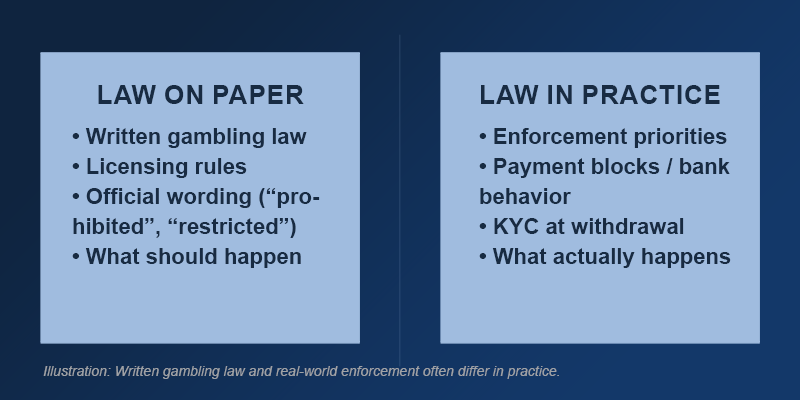
Law on Paper vs Law in Practice

When it comes to crypto gambling, what the law says and how it’s actually enforced are often two different things.

The written law defines what is technically permitted or prohibited, but enforcement behavior shows how authorities act in practice. In many countries, regulators focus their efforts on operators, payment providers, and large-scale activity rather than on individual players placing occasional bets.

This is why phrases like “rarely enforced” are common in crypto gambling discussions — but they should not be confused with legality. Low enforcement does not automatically imply that something is legal; it usually indicates that it is not a priority for regulators.

KYC & AML: A Regulatory Signal, Not a Feature

KYC and AML checks are often misunderstood in crypto gambling. They don’t make a casino “good” or “bad,” and they are not, by themselves, a bonus feature or a flaw. Instead, they serve as a regulatory signal, indicating which legal framework the casino operates under.

Platforms that enforce KYC and AML requirements are usually located in regulated or semi-regulated jurisdictions, where compliance, reporting, and consumer protection are priorities. Casinos that avoid KYC entirely typically operate offshore, under lighter or less formal oversight.

Neither model is inherently right or wrong — but they entail different legal expectations and player protections. Understanding this helps players interpret the environment they’re entering, rather than relying on marketing labels such as “no-KYC” or “fully verified.”

  • KYC casinos: Operate under licensed frameworks and require identity verification, usually offering higher levels of player protection.
  • No-KYC casinos: Typically operate offshore without identity checks for gameplay, providing easier access but higher risks for players.

How to Evaluate Whether a Crypto Casino Is Right for You

Before choosing a crypto casino, take a few simple steps to assess whether the platform fits your needs and risk tolerance.

1
Clarify your preferences
Decide what matters most to you — supported coins, games, privacy level, limits, speed, or ease of use. This prevents random or impulsive signups.
2
Shortlist suitable casinos
Use curated casino lists to filter platforms by cryptocurrency support, game selection, licensing, or region, and remove options that don’t fit.
3
Choose KYC or No-KYC
Decide whether you prefer licensed casinos with identity checks and higher protection, or offshore no-KYC platforms with easier access but higher risk.
4
Check trust and reputation
Look for independent reviews, player feedback, and references. Consistency, transparency, and a history of smooth withdrawals matter most.
5
Review payment and withdrawal rules
Confirm supported networks, fees, limits, and whether KYC is required at withdrawal. This avoids surprises when cashing out.
6
Start small and test the platform
Sign up, make a small test deposit, and play cautiously at first. This lets you assess reliability before committing larger amounts.

Important Legal Disclaimer

The information on this page is provided for general informational purposes only. It does not constitute legal advice and should not be relied on as a substitute for professional legal guidance.

Gambling and cryptocurrency laws vary by country and may change over time. While we aim to keep this information accurate and up to date, legal interpretations and enforcement practices can differ between jurisdictions.

Players are responsible for understanding and complying with the laws and regulations that apply in their own location before accessing any online gambling platform.

Table of Contents

Crypto Gambling Legality FAQ

Is using crypto itself illegal for gambling? Toggle

Usually no — crypto is a payment method, not a gambling license.

Most laws focus on whether online gambling is permitted and whether the operator is licensed. Crypto can add extra compliance rules (KYC/AML, reporting, payment controls), but simply paying with crypto rarely “changes” the legal definition of gambling in a country.

Can players get fined for playing at offshore casinos? Toggle

In some countries, yes — but enforcement is often aimed at operators, not casual players.

Where player penalties exist, they tend to show up through payment blocks, account freezes, or tax issues rather than criminal cases. The practical risk usually rises with larger activity, repeated withdrawals, or when local payment rails are involved.

Why do some casinos accept crypto deposits but block bank withdrawals? Toggle

Because “on-chain” transfers and local banking rails are regulated differently.

A casino may accept crypto because it avoids card networks and banks, but still restrict fiat withdrawals to reduce compliance pressure (KYC/AML, chargeback risk, bank scrutiny, jurisdiction limits). In many regions, cash-out is where regulation becomes real.

Does “grey area” mean it’s safe or legal? Toggle

No. Grey area means the rules are unclear — not that you’re protected.

In grey zones, the written law may be outdated or incomplete, and enforcement can be inconsistent. Your real-world risk is usually operational: payment issues, withdrawal verification, or limited consumer protection if something goes wrong.

Is “no-KYC gambling” legal, or just tolerated? Toggle

Most of the time, it’s tolerated rather than formally approved.

No-KYC access often signals an offshore or lightly regulated setup. It can be convenient, but it usually comes with fewer safeguards: weaker dispute options, higher account-risk during cash-out, and a greater chance of sudden verification requests if withdrawals get large.

Do VPNs change the legality of crypto gambling? Toggle

No — a VPN can change your IP location, but it doesn’t change the law that applies to you.

In many cases, VPN use is more about bypassing geo-blocks or accessing a site — not legal permission. It can also create practical risks (account reviews, delayed withdrawals, extra verification) if the platform flags location inconsistencies.

What’s the simplest way to judge risk as a player? Toggle

Look at what happens at cash-out.

If a country actively blocks gambling payments, or if a casino has unclear withdrawal rules, that’s usually a bigger practical risk than the headline “is it legal?” question. Players rarely run into problems at deposit — they run into them when withdrawing.

Can I rely on the casino’s license to be “safe” in my country? Toggle

A license helps — but it doesn’t override your local laws.

An offshore license can improve operator accountability, but your country may still restrict access, advertising, or payment processing. Treat licensing as a credibility signal, not as legal immunity.

Michal

Founder of DoubleTheBitcoin.net
Crypto Gambling Analyst & Content Editor

• Reviewed 50+ crypto casinos
• Specializes in blockchain-based betting systems
• Covering crypto gambling since 2020