
Provably Fair Verifier Tool
This tool allows you to independently verify whether a provably fair casino game result was generated fairly. By entering required values, such as the server seed, client seed, and nonce, you can reproduce the exact outcome and confirm that the casino did not manipulate the result.
Some casino runs a collection of in-house games. These are generally built on the Provably Fair algorithm. Select the casino and game you want to verify the results for. Each game may require different input details—such as a server seed, client seed, nonce, or game hash.
Compare the verifier’s output with the actual result shown in the game interface to confirm the casino’s fairness.
Provably Fair Verifier
- This tool is independent and is not operated, endorsed, or affiliated with Stake, BC.Game, or any other Bitcoin casino.
- The verifier is developed, tested and maintained by the DoubleTheBitcoin team using publicly documented provably fair algorithms.
- Last verification update: 2026
How to Use the Provably Fair Verifier
This provably fair verifier helps you quickly and easily check whether a game result was generated fairly by a crypto casino. Provably fair systems allow players to independently verify that outcomes were not manipulated and were determined using transparent cryptographic methods.
By using this verifier, you can confirm that the casino followed its stated fairness algorithm and that your game result was produced exactly as promised.
Get the inputs
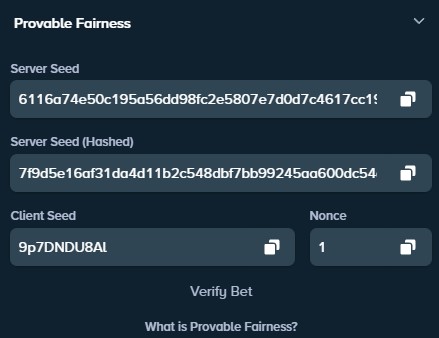
Open Provably Fair details and copy the seeds.
Paste into tool
Select casino + game, then paste values.
Run verification
Click Verify and compare with the game result.
Confirm match
If results match, the outcome was generated correctly.
Enter values
Based on the crypto game you’ve selected, you will be asked to enter the following details into the verifier tool:
- Casino: Select the crypto casino where the game was played. Each casino may use a slightly different provably fair implementation.
- Game: Choose the specific game you want to verify, such as Dice or Crash. Different games require different verification logic.
- Game Hash / Server Seed: Enter the game hash or server seed provided by the casino after the round was completed.
- Client Seed: Input the client seed used for the bet. This value is typically set by the player and ensures player influence over the result.
- Nonce: Enter the nonce value associated with the bet. The nonce increments with each wager and guarantees unique outcomes.
- Additional parameters: Some games may require extra inputs, such as salt values or house edge settings, depending on the casino’s algorithm.
Once all required values are entered, the verifier will automatically generate the expected game result. Compare this output with the result shown by the casino.
If both results match, it confirms that the game outcome was generated fairly and that the casino did not alter the result after the bet was placed.
How the Verifier Tool Works and Why It's Useful
This verifier recreates the exact algorithm used by the casino to generate game outcomes.
By combining the server seed, client seed, nonce, and any additional parameters, the tool independently recalculates the result and compares it with the outcome shown in the game.
Each supported game uses the casino’s publicly documented provably fair algorithm.
This typically involves cryptographic hashing (HMAC-SHA256 / SHA256), deterministic seed chaining, and precise float-to-result conversion logic.
Stake Dice: Provably Fair Example
Inputs: Server Seed, Client Seed, Nonce
Core step: Stake generates a deterministic hash using HMAC_SHA256(serverSeed, "clientSeed:nonce:0"). The hash is then converted into a random float and translated into a dice roll.
Example inputs:
Server seed: 49d8ad...97ed8
Client seed: sOuED3Jpw3
Nonce: 276
Step-by-step (simplified):
- Create hash: HMAC_SHA256(serverSeed, "sOuED3Jpw3:276:0")
- Convert first bytes into a float in range [0, 1)
- Translate to dice roll: roll = floor(float × 10001) / 100
What to check: If your verifier returns the same roll shown in the bet slip, the outcome was generated exactly from those inputs (i.e., provably fair).
Supported Games & Algorithms
Provably fair verification is not a one-size-fits-all process. Even when casinos use similar cryptographic principles, the exact implementation, input structure, and result calculation logic can differ significantly between games and platforms.
For this reason, the Provably Fair Verifier focuses on a curated set of games where the verification logic is fully documented, publicly auditable, and rigorously tested.
Each supported game is verified using the exact algorithm published by the casino, ensuring that the reproduced result matches the original game outcome with precision. It’s a general tool for Stake Dice verification and other well-known in-house games.
Check Fairness in These Games
Below is the current list of supported games for our verifier tool. Players often use it to verify BC.Game Crash or Stake Dice results after a round.
Why these games are supported
While many crypto casinos claim to use provably fair systems, not all publish sufficient technical details for independent verification.
To maintain accuracy and reliability, new games are only added once:
- Public verification logic: The full verification algorithm is publicly available and can be independently reviewed.
- Clearly defined inputs: All required inputs (seeds, nonces, hashes, salts) are explicitly defined by the casino.
- Reproducible results: The results can be reproduced consistently across multiple test cases using the same inputs.
Stake and BC.Game currently account for a large share of global crypto gambling activity and provide well-documented verification logic, making them ideal platforms for support. BC Crash or Stake’s Dice are popular among crypto gamblers, so it’s reasonable to help as many players as possible.
Additional games, such as Blackjack or Plinko, and more casinos will be added gradually as their implementations are reviewed and validated.
What Is Provably Fair?
Provably fair is a system that allows players to verify whether a casino game result was generated fairly. Instead of blindly trusting the casino, players can check the outcome themselves using cryptographic data provided after each round.
In simple terms, provably fair ensures that:
- The casino couldn’t change the result after the bet was placed
- The player had influence over the randomness
- The final outcome can be reproduced using the same inputs.
This system doesn’t make games more profitable and easier to win, but it does make them transparent and verifiable.
How Provably Fair Works (Step by Step)
While the technical details can vary by game and casino, the general process follows the same logic:
- Server seed commitment: The casino commits to a secret value (server seed) before any bets are placed.
- Player input: The player provides their own input (client seed), adding player-side influence over the result.
- Nonce increment: A nonce or counter ensures that every bet produces a unique outcome.
- Result generation: A cryptographic algorithm combines these values to generate the game outcome.
- Data reveal: After the round, the casino reveals the relevant data so the result can be independently verified.
By replaying the same calculation using the revealed inputs, anyone can confirm that the result matches exactly what was shown in the game.
- The server seed is revealed only after you manually rotate your seeds. Until then, the casino displays only a hashed version, which serves as a commitment but cannot be used to verify results. The hashed server seed alone is not sufficient to reproduce game outcomes. Full verification requires the unhashed server seed revealed after rotation.
What Does a Successful Verification Mean?
A successful verification means the verifier’s result exactly matches the casino’s result. This confirms that the casino adhered to its published provably fair algorithm and that the result was not modified after the bet was placed.
In short, it proves that the game behaved exactly as advertised.
What If Verification Fails?
If the verifier produces a different result than the casino, it doesn’t automatically mean foul play—but it does mean something is off.
Common reasons for failed verification include:
- Incorrect or incomplete input values.
- Using the wrong game or casino selection.
- Mixing up server seed and server seed hash.
- Entering the wrong nonce or game hash.
If all inputs are correct and the result still doesn’t match, it’s a strong signal that the round deserves closer scrutiny.
Common Provably Fair Myths
Let’s clear up a few of the most common misconceptions about provably fair algorithms and how casinos really operate.
“Casinos can still rig results”
A properly implemented provably fair system prevents casinos from altering results after the bet is placed. Once the casino commits to a server seed, changing outcomes without breaking cryptographic proofs becomes practically impossible.
That said, provably fair only works when the implementation is transparent—which is why independent verification matters.
“Provably fair guarantees winning”
Provably fair does not improve your odds or guarantee profits. It simply ensures that randomness is honest and that losses result from probability—not manipulation.
You can still lose many bets in a row and remain fully verified.
“Only works for crypto casinos”
While provably fair is most common in crypto casinos, the concept itself isn’t limited to crypto. It just happens to be easier to implement in blockchain-based environments where transparency is expected.
Some traditional platforms use similar ideas—but rarely with the same level of public verification. BGaming and Spribe are among the providers known for implementing Provably Fair systems.
Final Thoughts
Provably fair systems give players something that traditional online gambling rarely offers: verifiable transparency. Instead of relying on trust alone, you can independently confirm that a game result was generated exactly according to the casino’s published rules.
Our verifier tool doesn’t promise wins or predict outcomes—but it does give you clarity. If the inputs are correct and the verification matches, you know the game behaved fairly. And if something doesn’t line up, you have a clear signal that the result deserves a closer look.
As crypto casinos continue to evolve, tools like this become increasingly important. Transparency, reproducibility, and independent verification are what set genuinely fair platforms apart from those that merely claim to be.
Provably Fair Verifier Tool FAQ
What does the verifier tool actually check?
The verifier checks whether a specific game result was generated according to the casino’s published provably fair algorithm. By reproducing the outcome using the same inputs (such as seeds, nonce, or game hash), it confirms whether the result matches exactly what the casino displayed.
Can this tool predict future game results or winning streaks?
No. The verifier cannot predict future outcomes or identify winning patterns. Provably fair systems are deterministic only after the inputs are known, meaning results can be verified retrospectively but not predicted in advance.
What should I do if my game result doesn’t match the verifier output?
First, double-check that all input values were entered correctly and that the correct casino and game were selected. If the inputs are accurate and the result still doesn’t match, it may indicate an issue with the data provided or the game round itself and deserves further investigation.
Do all crypto casinos use the same provably fair algorithm?
No. While most provably fair systems rely on similar cryptographic principles, each casino—and sometimes each game—can implement its own variation. This is why verification logic must be tailored to specific casinos and games.
Does provably fair increase my chance of winning?
No. Provably fair does not change the odds or increase your chances of winning. It simply ensures that game results are generated fairly and transparently, without manipulation after the bet is placed.
Can casinos change results after a bet is placed in a provably fair system?
When implemented correctly, a provably fair system prevents casinos from changing results after a bet is placed. The casino commits to key values in advance, making post-bet manipulation cryptographically detectable.